Exhibits
Welcome to the Exhibits: a sprawling, ever-expanding treasury of curiosities drawn from the far corners of history, geography, and human folly. Here, in the shadow of Sutch Manor, we gather the improbable, the illustrious, and the mildly concerning—objects whose stories stretch from Montparnasse studios to long-haul flights over the Indian Ocean, from Dutch laudanum-fuelled reveries to the hallowed foam of a Sky Sports microphone.
Each piece in this collection carries its own mythology: some whispered, some loudly disputed, some so outrageous they must surely be true. Together they form an eclectic archive of heroism, mischief, artistic brilliance, and the occasional act of questionable judgement. This is not a museum in the traditional sense; it is a living anthology of human endeavour, stitched together with equal parts scholarship and sheer audacity.
Wander through and you'll find yourself transported—one moment standing beside a wartime agent outside a Parisian café, the next marvelling at the aerodynamic properties of a stubby cooler that once witnessed feats of athletic drinking unmatched in modern civilisation. Turn a corner and you may encounter a forgotten sketch that shaped Romanticism, or a pop-cultural collage so densely packed with icons it threatens to collapse under the weight of its own legend.
The Exhibits invite you not merely to look, but to imagine: to fill in the gaps, question the narratives, and revel in the delightful chaos of a collection that refuses to behave. Everything here has a story. Some are documented. Some are disputed. Some are still being invented.
Step inside. Let curiosity take the wheel. The world is wider, stranger, and far more entertaining than you remember.
LWWRFC Trophy
Exhibit: 19.1
Artist: The Hon. Mr Sids.
Media: Oak and Silver
Size: 5 in. x 4in. x 1/2in.
Catalogue Number: 932/808-fxl
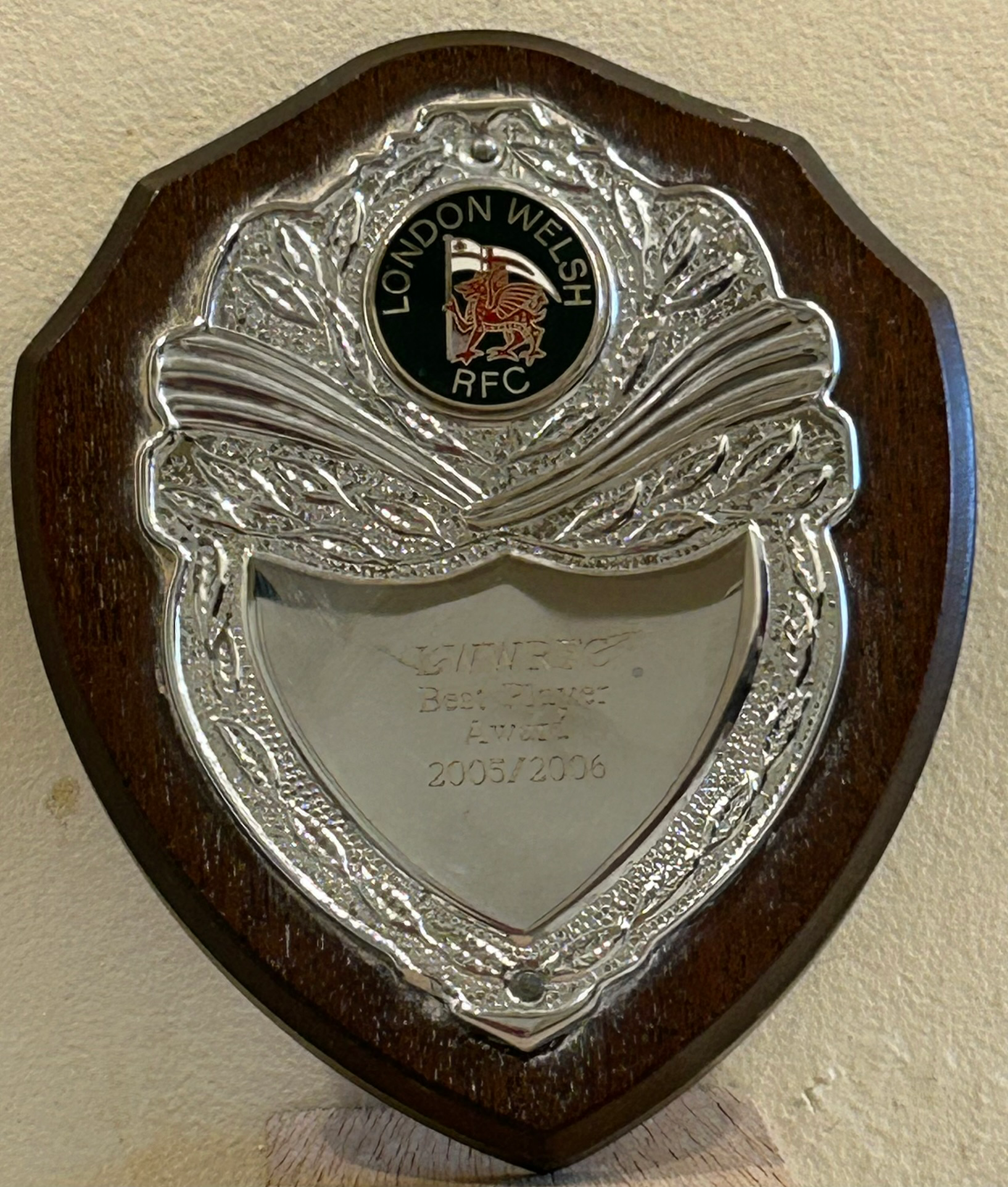
The LWWRFC sheild was commissioned in 1921 and made by master silversmith, The Hon. Mr Sids of Fulham Palace Road. Crafted from Oak from the New Forest and silver from the mines of Cornwall the distinctive embossed design is a hallmark of the great man's skill.
Lady Georgina, a handsome woman often with a retinue of ingenue, was a renowned amateur sportswoman and ardent suffragette, she often took part in all female grappling sports and represented England in the Home Games of 1925 in Greco-Roman Wrestling beating Sylvia Down-Syndrome, great aunt of Leslie in the 3rd place tug off after defeat to to Henrietta Money-Coutts in the semi final.
The 1921 trophy was awarded to her as the best player Futch Class in the Looe Women's Wrestling Ribband (LWWRFC), Cornwall. The marathon event lasted 76 days and Lady G. recorded 2005 wins out of 2006 bouts.
Interestingly the bout she did not win was a tie with Lady Victoria Whittingham-Juffs. Described in The Times as “A sweaty affair lasting many hours. Both fell to the floor exhausted and were later revived with a concoction of asafoetida, dried Valerian rootlets and rum.”
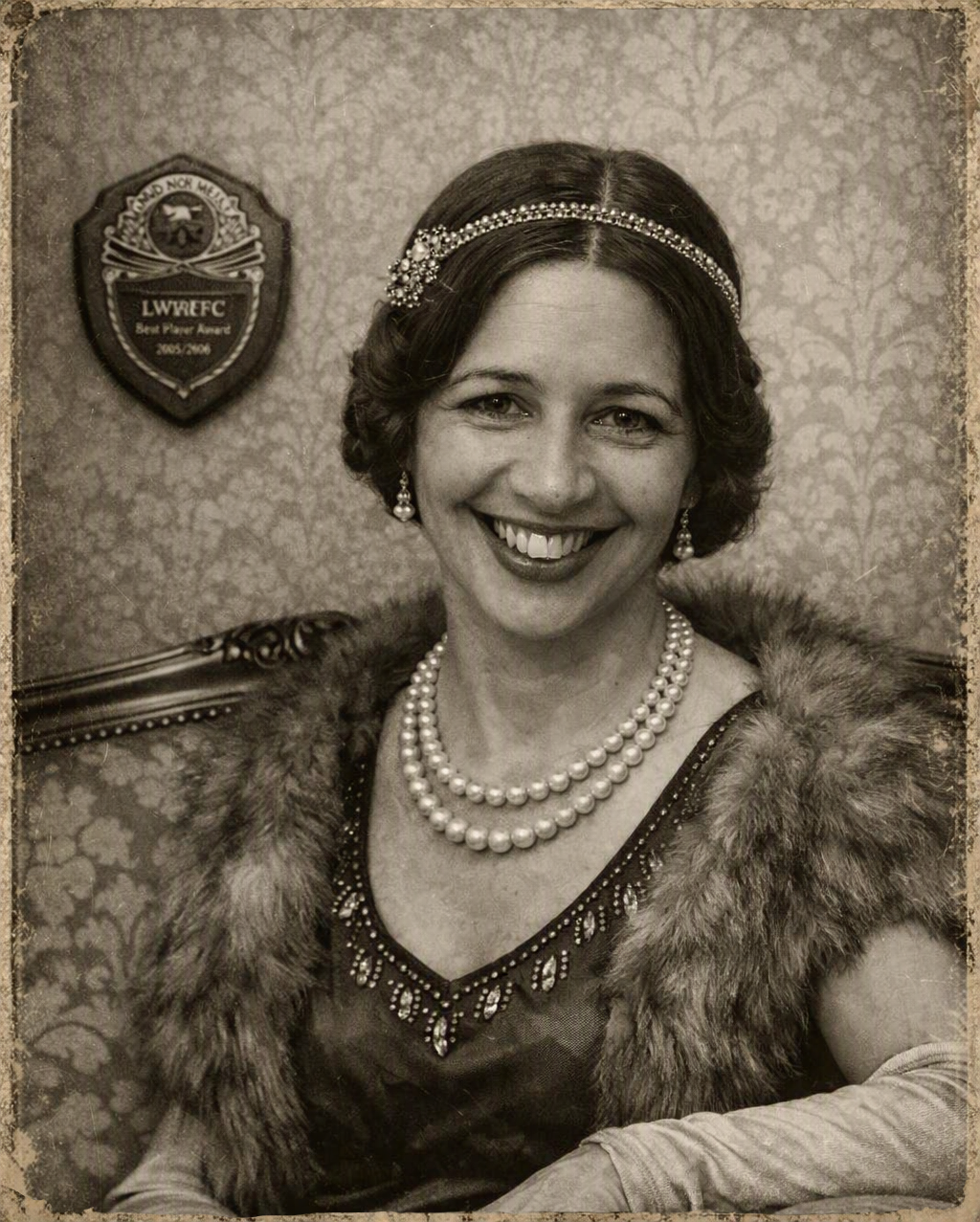
Lady Georgina
Photographed in the Drawing Room of Sutch Mannor, 1925.
Maighstir Pádraig Marionette
Exhibit: 72.a
Artist: Unknown.
Media: Cotton polyester blend
Size: 14 in. x 8in. x 4in.
Catalogue Number: 002/941-jkj
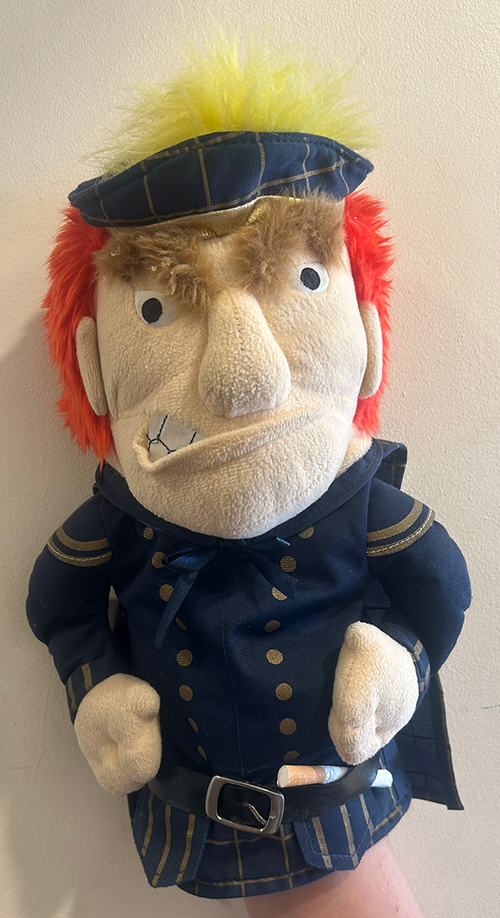
The origins are uncertain, the earliest documented information can be found in the 16th Century Clan Chattan Chronical. They describe a fearsome looking marionette in full battle dress referred to as Maighstir Pádraig (trans. Mr. Pat). The original purpose is lost to history. Sir Thomas Devine, the renowned Scottish historian thought he was originally a device to cause children to pick up and fold their clothes. He believed that children were told that Pat would emerge from the mass of kilts crumpled on the floor and bludgeon the child with his cudgel. Some parts of Midlothian use the phrase "Pat up yer claes" to this day.
Mr. Pat is now familiar to everyone across the British Isles for his part in the traditional sea-side entertainment “Pat & Mhairi”. Where the hard drinking, constantly broke, titular character subjugates his spouse, who he blames for his situation, through various hilarious physical and emotional turmoils.
“Mr. Pat” housed at Stu's Shack is a particularly venomous incarnation. The original artist is unknown, however it is believed to have been manufactured in Shieldaig, a quiet fishing village in the northwest Highlands of Scotland. This rare example of a c.1870 Pat is in excellent condition with only minor organic stains along the rear.
Maighstir Pádraig has been cited by many as inspiration in their creative work. Notably: Irvine Welsh used key concepts when creating the character Francis Begbie in Trainspotting. Orson Welles incorporated many of the traditional behaviours into his Harry Lime role in the 1949 motion picture The Third Man and John Cunniliffe has taken an almost direct translation for his 1980's childrens' character Postman Pat.
The Gay Old Gentleman of Paris, with Onions
Exhibit: 183.g
Artist: H.M. Carr.
Media: Oil on canvas
Size: 130in. x 86in.
Catalogue Number: 453/123-anw
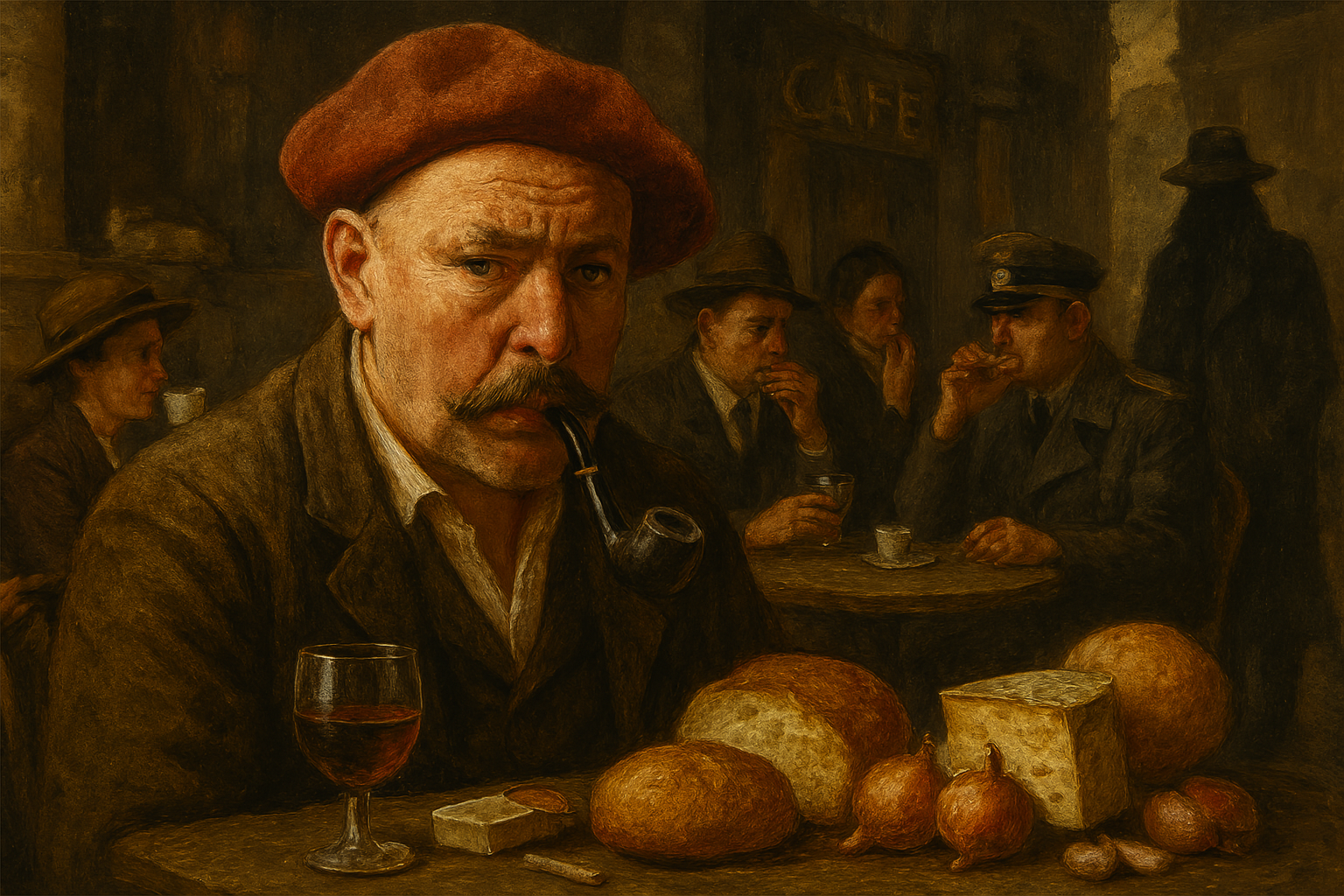
This mid-sized canvas was painted by World War II artist, and dour Yorkshireman, Henry Carr (1894-1970) in 1945 at his Montparnasse studio in Paris.
The Baroque-inflected realism with narrative figuration painted by Carr captures Special Operations Executive agent Sir Lionel Sutch CSE, KJ, outside Café de on the left bank of the Seine in the 6th arrondissement during the last days of the occupation of Paris.
The direct gaze of Sir Lionel anchors the viewer in a moment of quiet confrontation. He is not merely a subject; he is a witness, a narrator, and perhaps a cipher for the artist's own commentary.
The use of chiaroscuro is subtle but effective: warm, ambient light bathes the foreground, while the background recedes into shadow, punctuated by the ominous silhouette near the café entrance. This interplay of light and dark suggests not only spatial depth but moral ambiguity—a tension between comfort and threat; the flamboyant biting down on the pipe suggesting the true grit and superiority of the Englishman.
Carr was criticised in 1956 by David Sylvester for the lazy iconography with cheese, onions and garlic visible on the table. This caused a life-long feud between the two.
Historian M. R. D. Foot in his 1984 book “SOE: The Special Operations Executive” confirms that Sir Lionel mostly lived on a diet of onions and garlic as a way to maintain his cover and repel intimate interactions with the Germans.
Sir Lionel was head of the SENDFOR circuit from 29th July 1944 until the liberation of Paris 20 days later. Sir Lionel was later awarded the Ordre national de la Légion d'honneur, Grand-croix. SENDFOR is believed to be a play on the French word of s'enfuir, a motto that served Sir Lionel well. In time of distress Sir Lionel would rally his group with the shout "s'enfuir de la bataille".
A Stubby Cooler
Exhibit: 491.6
Manufacturer: APJ Manufacturing Inc., Geelong
Meterial: Neoprene and screen print
Size: 3in. x 4in.
Catalogue Number: 912/646-qtt

In 1977 Doug Walters dared to imagine the impossible. The greatest feat in history by any Australian cricketer, the greatest feat in the history of any cricketer, indeed, any human.
On a flight between Australia and the UK Walters attempted to drink as many stubbies as possible during the journey. Walters was an aggressive top order batter and equally aggressive drinker. The stubby is a small can of larger with 4.6% ABV containing 375ml of liquid.
Commentating on the 44th and final Stubby, ABC's legendary radio commentator, Alan McGilvray, said "Walters, opens the tin, it's well tipped back. Moving forwards Walters gulps. It races down his neck. Applause, in 1020 minutes we have seen a glorious innings by Walters. A triumph of human endurance that will surely never be beaten."
However, only six years later the record was passed. The greats of the era, Botham, Chappel, Border would be reasonable guesses, but it took a man with a singular determination and a dedication not previously seen. Step forwards Rodney William Marsh MBE. A no-nonsense wicket keeper with alcohol in his veins. Marsh successfully consumed 51 cans. Marsh was removed from the plane by team mates on a luggage trolly.
By this point the Australia's men's team had turned the art of consuming stubbies on a 17 hour flight into a science. The most daring attempt yet was meticulously planned.
In 1989, step forward one David Clarence Boon. The diminutive number 3 batsman stood at 5ft 3in in his webbed stockings. Eye witnesses said the attempt started slowly, Boon was supported in the early rounds by opener Mark “Tubby” Taylor and mustachioed medium slow swing bowler Merv Hughes. Recognising that Boon was falling behind the run rate Dean Jones stepped in to act as pace maker, increasing the flow by 1.25 cans per hour (cph).
Jones, with his job done, passed out. Boon now set out alone. Over the next several hours Boon moved past 30 and into the nervous 40s. With the flight in sight of London Heathrow Boon was still 1 short of the record. At this point the pilot made the pivotal decision to "go round" buying Boon the time he needed. Shortly before touchdown, with great excitement, Captain Andrew Roberts announced the illustrious words "Ladies and Gentleman, we sit here as mortals in the presence of gods, David Boon has done it!".
Boon drank his 52nd and last can of Victoria Bitter (VB) in sight of the runway. On landing, Boon went on to a reception where he drank more before falling into a blissful sleep lasting 36 hours and missing 2 practice sessions.
David Clarence Boon quaffed 19.5 litres of beer of which 897ml was pure alcohol. He went on to become a successful match referee and brand ambassador for VB and was awarded an MBE for service to the entertainment industry.
The stubby cooler displayed is believed to be the second one used by Boon during his epic flight. The only other known surviving cooler is in the Smithsonian Institute, Washington D.C.
Two Queens
Exhibit: 69.67
Artist: S. Van Barr
Meterial: Pencil sketch on parchment
Size: 5in. x 5in.
Catalogue Number: 399/381-ohz
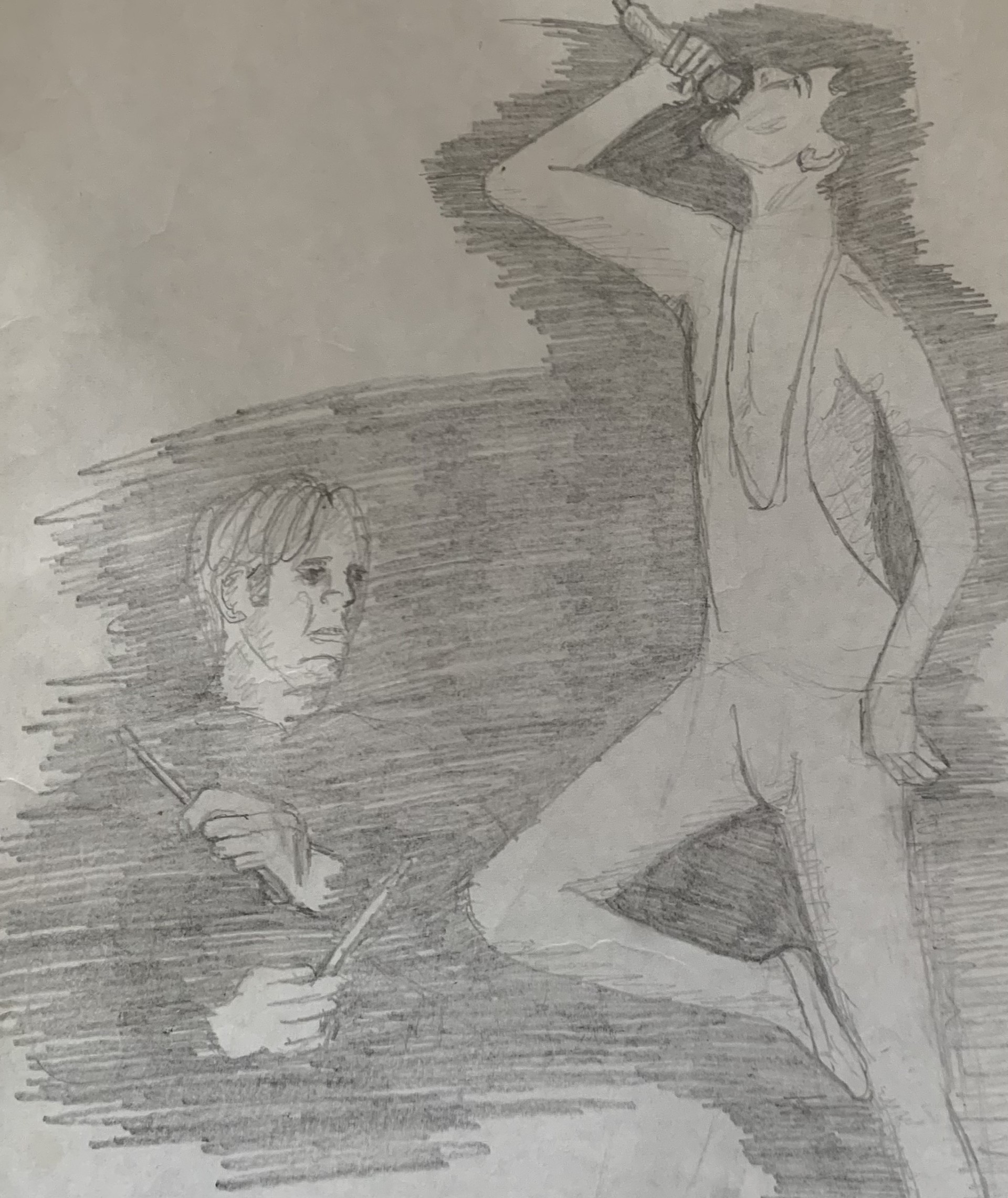
Two Queens is a little-known sketch executed by the Dutch master Van Barr in 1832, a period in which his work was increasingly marked by visionary intensity and psychological ambiguity. Contemporary accounts suggest that the drawing's initial impetus derived from a homoerotic reverie induced by an excessive dose of laudanum. An origin that, while impossible to verify, has become part of the sketch's enduring mythology.
Formally, the composition is deceptively modest: two figures engaged in a curious, almost ritualistic interaction. The seated figure appears to confront the unfamiliar mechanics of chopsticks, his hesitant gestures conveying both concentration and a faint sense of bewilderment. Opposite him, the standing figure consumes a turnip with exaggerated flourish, an act whose theatricality introduces a note of playful disruption into an otherwise contemplative scene. The juxtaposition of earnest inquiry and flamboyant display has long been cited as emblematic of Van Barr's interest in the tension between discipline and excess.
The sketch would later serve as a point of departure for Van Barr's now-lost masterpiece, Puw Julist Enters the Ring. The destruction of this work by German forces in 1941 has only deepened its aura, allowing speculation to flourish in the absence of the object itself. Scholarly opinion remains sharply divided: some critics interpret the composition—known only through early descriptions and a handful of preparatory studies—as a stylised representation of a gladiator's ceremonial entrance. Others, adopting a more provocative reading, claim that when viewed with narrowed eyes and from an angle, the scene reveals a disturbingly transgressive encounter between a male figure and a deeply violated child's rocking horse in a most debased act. This latter interpretation, though controversial, has persisted in academic discourse, largely due to the Romantic era's fascination with the boundaries between the heroic, the grotesque, and the absurd.
Regardless of such debates, Van Barr's influence on the development of Romanticism is undeniable. Painters such as Schelfhout and Koekkoek exhibit clear affinities with his hallmark sensibilities—particularly his blending of the mundane with the fantastical, and his willingness to court ambiguity as a central aesthetic strategy.
Van Barr's reputation extended far beyond the nineteenth century. In a 1981 interview on the Argentine channel El Siete, Freddie Mercury expressed admiration for the artist's idiosyncratic vision. Following Mercury's death, bassist John Deacon remarked that he had long believed the band's name was, at least in spirit, indebted to the irreverent energy of Two Queens.
Sky Sports Microphone Cover
Exhibit: 17
Manufacturer: MicWinshields, Bratislava
Meterial: High-density, open-cell polyurethane foam
Size: 3in. x 3in.
Catalogue Number: 036/036-aaa

The iconic Sky Sports microphone cover is a symbol of the network's commitment to delivering high-quality sports coverage. The cover, emblazoned with the distinctive Sky Sports logo.
Manufactured in Slovakia by MicWinshields, the cover is made from high-density, open-cell polyurethane foam. This material is chosen for its excellent sound absorption properties that helps to reduce wind noise and other unwanted sounds during outdoor broadcasts. The cover's size, measuring 3 inches by 3 inches, is designed to fit snugly over the microphone, providing optimal protection while allowing for clear audio capture.
The microphone cover in question is believed to have possibly been used by Wayne 'Hawaii Five Oh One' Mardell. The legendary darts commentator is known for his distinctive voice and enthusiastic commentary style, making him a beloved figure among darts fans. Mardell's association with the Sky Sports microphone cover adds an extra layer of significance to this exhibit, as it represents not only the technical aspect of sports broadcasting but also the human element that brings the excitement of the game to life for viewers around the world.
Mardell, often described as the poor man's Sid Waddell, has been a fixture in the world of darts commentary for decades.
Stugent Pepper's Lonly Hearts Club Band
Exhibit: 90.4
Artist: Dylsie
Meterial: Print on paper
Size: 4in. x 4in.
Catalogue Number: 074/425-sut
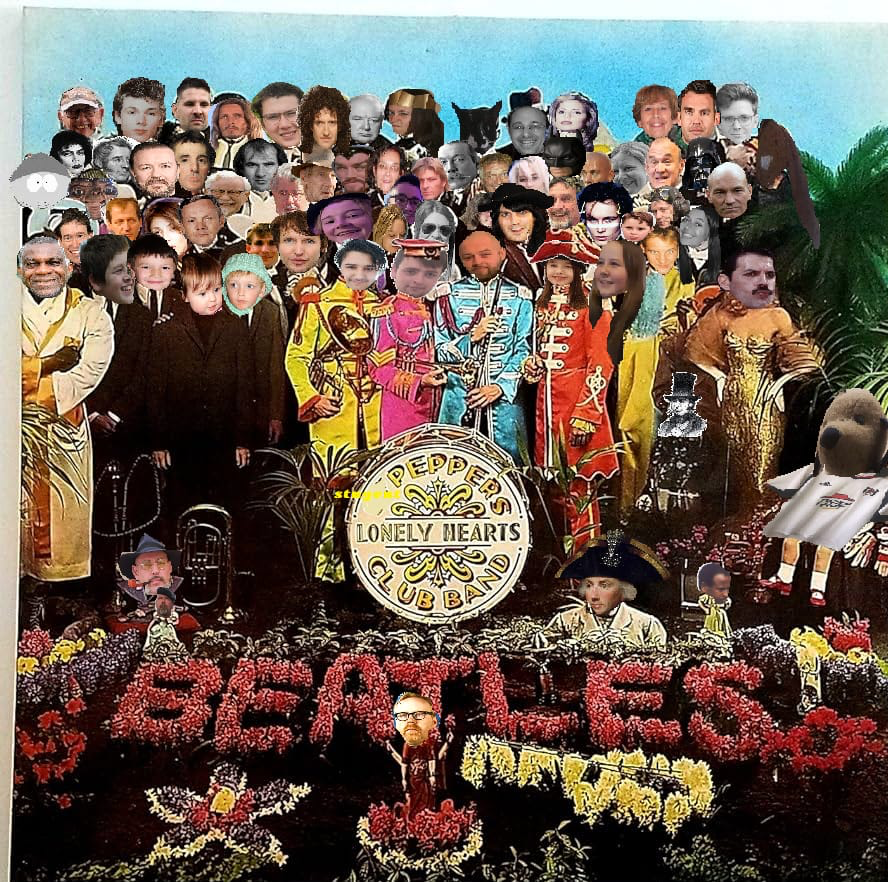
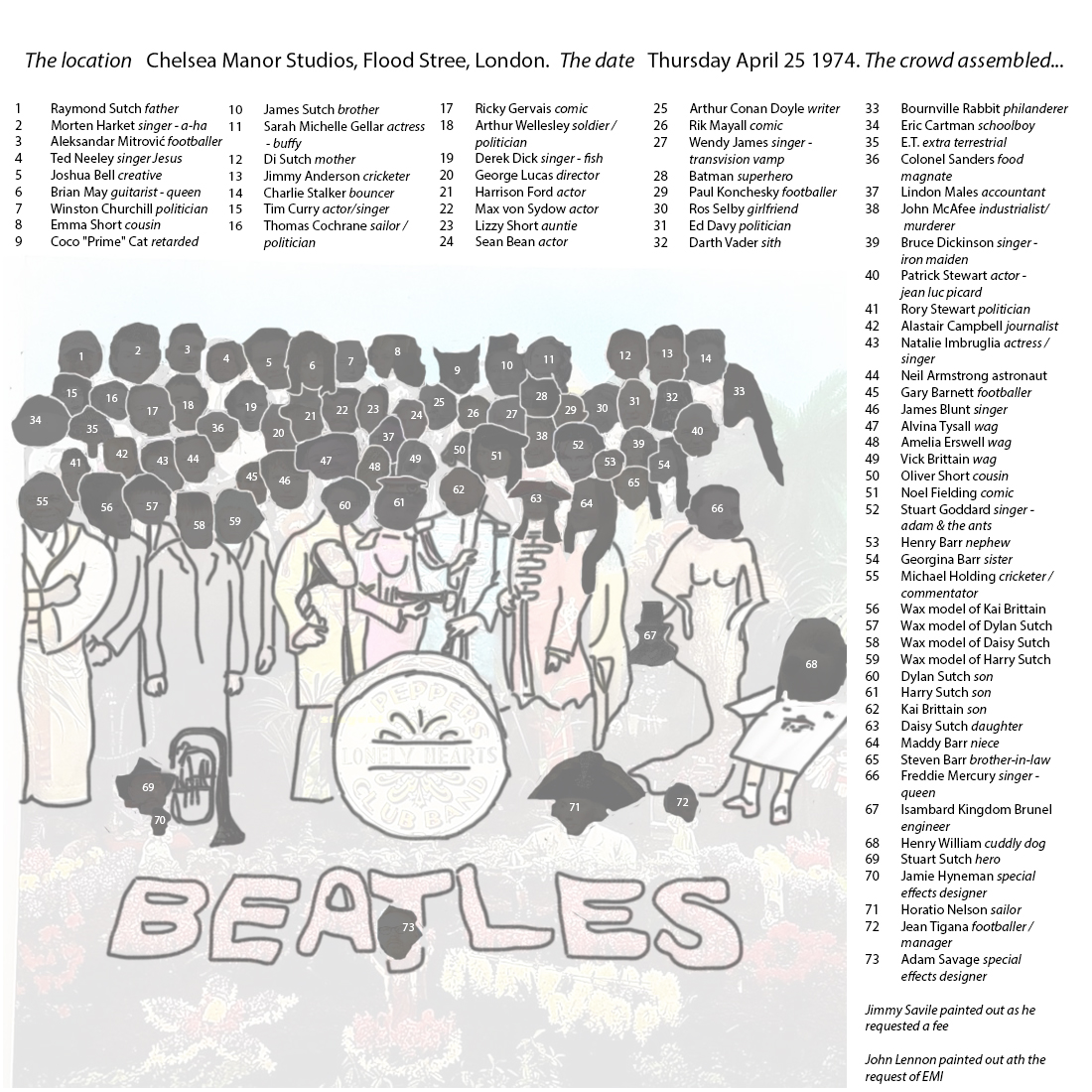
The iconic cover was designed by gritty street artist Dylsie. The cover features many influnces on the life of proprietor, Stu. From the mundane such as his parents to global icons such as Paul Konchesky and Lindon Males.
In the Andy Warhol Diaries, currated by Pat Hackett, it provides a candid and detached perspective on the composition, art, and 1960s-80s pop culture. Warhol said:
The colour composition presents a densely populated tableau in which historical figures, cultural icons, family members, and fictional characters coexist in a single, meticulously orchestrated plane. Individuals such as Winston Churchill, Arthur Conan Doyle, and Isambard Kingdom Brunel stand alongside contemporary performers like Brian May, Derek Dick, and Morten Harket, while fictional presences—Batman, Darth Vader, and E.T.—disrupt any attempt at strict historical categorisation.
This deliberate collapsing of temporal, social, and ontological boundaries transforms the image into a commentary on the porousness of modern celebrity culture. The inclusion of intimate family figures—Raymond, Di, and Daisy—further destabilises traditional hierarchies by placing private identity on equal footing with global renown. The result is a visual manifesto for late-twentieth-century pop culture's democratisation, where the distinction between statesman, entertainer, relative, and fictional construct dissolves into a single shared mythology.
By assembling figures as disparate as astronaut Neil Armstrong, cricketer Jimmy Anderson, and special-effects innovators Jamie Hyneman and Adam Savage, the image asserts that cultural influence is no longer linear or stratified but accumulative, recombinant, and endlessly self-referential—an emblem of how modern culture absorbs, reconfigures, and re-mythologises its icons.
Finally, having the word 'Beatles' etched at the bottom of the composition is a clear goading to John Lennon who wished he had thought of it.